Cracking the Code: How Restaurant Wine Lists Are Built to Confuse — and Where the Real Value Hides
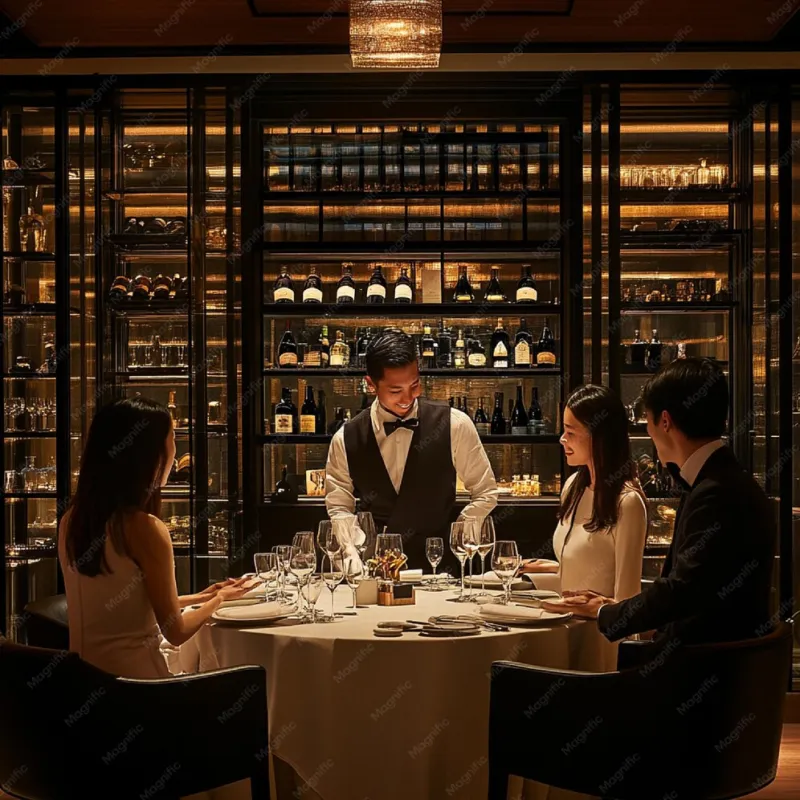
Photo: restaurant sommelier presenting wine list to couple at dinner table, via img.freepik.com
There is a particular kind of paralysis that descends on even seasoned diners the moment a leather-bound wine list lands on the table. The columns stretch across unfamiliar regions, the producer names read like a foreign-language exam, and the prices seem to follow no discernible logic. This experience is not accidental. The modern restaurant wine list is, in many respects, a carefully engineered document — one shaped by margin targets, supplier relationships, and a sophisticated understanding of how people make decisions under pressure.
Understanding what is actually happening on that list will not only spare you the anxiety of guessing blindly. It will help you find the bottles that represent genuine quality, the ones sommeliers themselves tend to reach for when nobody is watching the check.
The Markup Architecture You Were Never Supposed to Notice
Most American restaurants apply a standard markup formula to their wine inventory, typically ranging from two-and-a-half to four times the wholesale cost. At the lower end of a list — bottles priced between $40 and $60 — the markup percentage tends to be highest. A wine that costs the restaurant $12 wholesale might appear on the list at $48. Move toward the upper tier, and the percentage often softens, though the absolute dollar margin grows substantially.
This creates a counterintuitive reality: the least expensive bottles on a wine list are frequently the worst value in proportional terms. Restaurants know that budget-conscious diners gravitate toward the second-cheapest option on any given list — a behavioral pattern so well-documented in the hospitality industry that it has a name. The second-cheapest bottle is almost always engineered to carry the highest margin.
The practical takeaway is straightforward. If your instinct is to scan the lower third of the price column, resist it. Moving slightly upward — into the $65 to $90 range at a mid-tier American restaurant — often yields bottles that cost the restaurant considerably more at wholesale but are priced with a narrower percentage markup.
Obscure Producers and the Geography of Confusion
A wine list populated with recognizable names — Caymus, Meiomi, Kim Crawford — is a list built for volume, not discovery. Those labels carry significant marketing overhead, which is baked into their wholesale cost, and restaurants acquire them precisely because they sell themselves. The customer recognizes the name, feels reassured, and orders without hesitation.
The deliberate inclusion of obscure producers from lesser-known appellations serves a different purpose. On one level, it reflects genuine curatorial ambition — a sommelier who has sourced a small-production Grüner Veltliner from Austria or a Txakoli from Spain's Basque Country is often doing so because the wine is exceptional and underpriced relative to its quality. On another level, unfamiliar names create a knowledge gap that can prompt diners to defer entirely to the sommelier's recommendation — which may or may not align with the diner's actual preferences or budget.
The presence of obscure labels is not itself a red flag. In fact, it is frequently a signal that the list rewards exploration. But the mechanism of confusion it creates is worth recognizing for what it is.
How Sommeliers Actually Drink
Ask a working sommelier what they order when dining out on their own time, and a pattern emerges quickly. They tend toward regions that are structurally undervalued — not because those wines are unfashionable, but because the market has not yet caught up with their quality. Regions like the Finger Lakes in New York, the Willamette Valley's less-celebrated sub-appellations, and imported categories like Beaujolais cru, Languedoc-Roussillon, and southern Italian varieties from Campania or Sicily consistently appear in these conversations.
The reasoning is simple: sommeliers understand that prestige pricing in wine is partially a function of reputation, not solely of quality. A Barolo from a celebrated producer in a celebrated vintage carries a premium that reflects decades of marketing as much as it reflects what is in the glass. The Dolcetto from the same region, or a Barbera d'Asti from a less-heralded producer, may offer comparable pleasure at a fraction of the cost.
At a restaurant, this logic translates into a practical strategy. Look for wines from regions that carry less brand recognition. If a list features a Sicilian Nero d'Avola alongside a California Cabernet at a similar price point, the Sicilian wine likely cost the restaurant significantly less at wholesale — meaning it may represent considerably better value per dollar.
Reading the List as a Document of Incentives
Restaurants do not build wine lists in isolation. Distributors, importers, and supplier representatives play an active role in shaping what appears on any given list. Wines that are heavily pushed by a distributor — often because a restaurant has agreed to a volume-based arrangement — may appear prominently on a list not because a sommelier selected them on merit, but because a commercial relationship made them available at favorable terms.
This does not mean those wines are poor. It does mean that the most prominent placement on a list — the wines featured on a dedicated "house selection" page, or highlighted with a staff pick designation — should be evaluated with mild skepticism. Placement is not always a function of quality.
Conversely, wines tucked into the back pages of a list, organized under a heading like "Sommelier's Selection" or grouped by grape variety rather than region, are often there because someone with genuine knowledge chose them specifically. These are frequently where the intellectual honesty of the list resides.
Practical Strategies for Your Next Dinner
Armed with this framework, a few concrete approaches will serve you well at any American restaurant.
Engage the sommelier directly — but frame the conversation around your preferences, not your budget. Describing what you enjoy ("I tend to like wines with good acidity and a bit of earth rather than a lot of fruit") will elicit more useful recommendations than stating a price ceiling, which can prompt a sommelier to steer toward whatever margin-friendly option fits that number.
Ask what the sommelier is excited about right now. This question bypasses the commercial architecture of the list entirely and invites a genuine answer. Most sommeliers will respond with something they actually believe in.
Look for the by-the-glass program as a diagnostic tool. The wines a restaurant chooses to offer by the glass are often the ones the sommelier is most confident in — both because they are pouring them repeatedly and because they need to stand on their own merits at smaller volumes.
Treat unfamiliar names as an invitation, not a warning. A producer you have never encountered is not inherently a risk. It is an opportunity — and with a brief, direct question to your server or sommelier, you can quickly determine whether that unfamiliar bottle is an undiscovered gem or simply a high-margin placeholder.
Restaurant wine lists will likely always contain some degree of deliberate complexity. The business incentives that shape them are real and unlikely to disappear. But the knowledge that those incentives exist is itself a form of navigation. Once you understand that a wine list is as much a commercial document as a culinary one, you are no longer a passive reader. You become someone who knows where to look — and more importantly, where the value has been quietly waiting for you all along.
At Bebo Vino, we believe that understanding wine should extend beyond the cellar and into every setting where a glass is poured. Browse our curated selections to discover the kinds of bottles that sommeliers keep to themselves — delivered directly to your door.