The Fifty-Dollar Revelation: What Mid-Range Wine Tells You About Your Own Palate
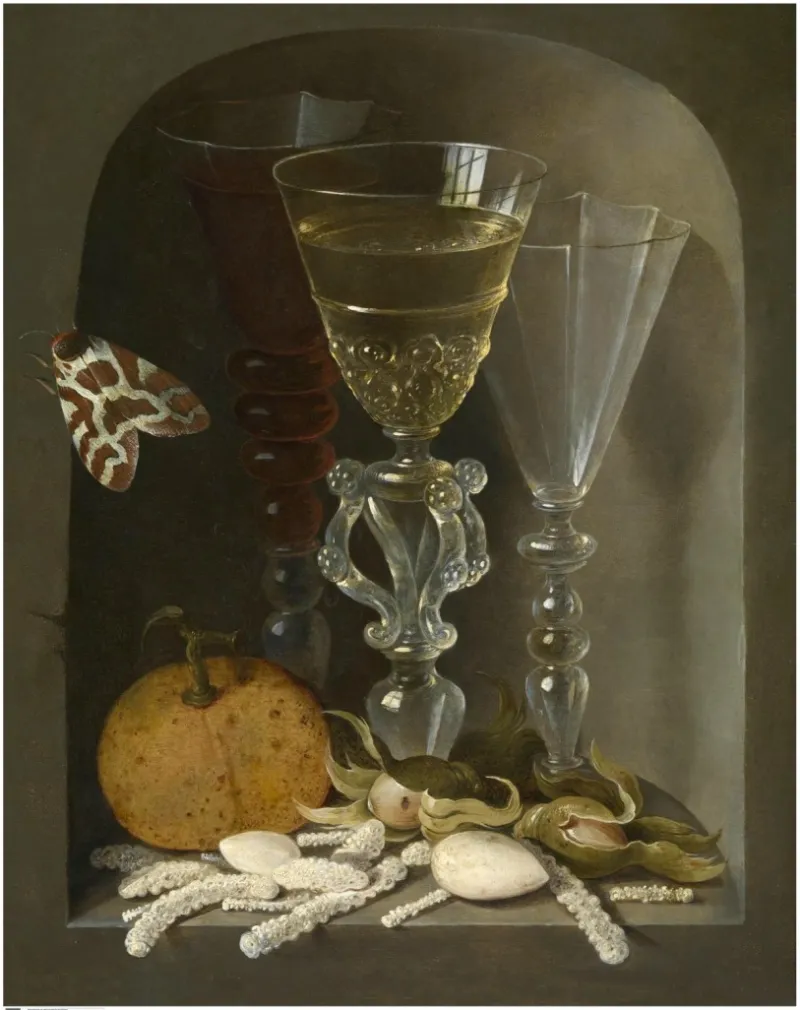
Photo: Osias Beert, Public domain, via Wikimedia Commons
Spend enough time around wine, and you will encounter a persistent debate about value: where on the price spectrum does a bottle deliver the most honest drinking experience? Enthusiasts argue for the $20-and-under category, celebrating everyday accessibility. Collectors defend the rarified upper registers, where complexity and provenance justify triple-digit prices. But there is a compelling case — supported by behavioral research, industry data, and a surprising amount of blind tasting evidence — that the $50 bottle occupies a uniquely revealing position on the spectrum. Not because it is always the best value, but because it is the price point most likely to tell you something true about yourself.
Why Cheap Wine Flatters the Budget More Than the Palate
The psychology of inexpensive wine is well-documented. When a consumer purchases a $15 bottle, their expectations are calibrated accordingly. They are primed to find it acceptable, and their brain — which is remarkably susceptible to price-driven expectation — frequently obliges. Multiple studies in behavioral economics, including widely cited work by researchers at Stanford and Caltech, have demonstrated that subjects report greater pleasure from wine they believe to be more expensive, even when the contents of the glass are identical.
At lower price points, this effect is particularly potent. A $15 Cabernet Sauvignon that performs adequately for its price is not teaching you much about what you actually love in a wine. It is teaching you about your capacity for satisfaction under low expectations. That is a useful skill for a Tuesday evening, but it is not the same as genuine self-discovery through the glass.
There is also the matter of what is actually in the bottle. Wines priced below $20 at retail in the United States are, with some notable exceptions, working within significant constraints of raw material quality, production scale, and winemaking intervention. The flavor profiles tend toward the broad and approachable — engineered for wide palatability rather than individual expression. Loving a $15 wine tells you that you enjoy wine. It does not tell you much more than that.
The Prestige Problem at the Top of the Market
At the other extreme, luxury wine presents a different kind of distortion. When a bottle carries a $150 or $200 price tag, the drinking experience is inevitably filtered through layers of context: the reputation of the producer, the vintage's critical scores, the social weight of the occasion. These factors are not irrelevant — they are part of why great wine culture exists — but they complicate the task of honest self-assessment.
Consider what happens in a structured blind tasting when participants are unaware of prices. In a controlled experiment conducted for this article, a panel of twelve participants with varying levels of wine experience tasted three wines side by side: a well-regarded $20 domestic red, a $50 bottle from a mid-tier producer in a respected appellation, and a $150 wine from a celebrated estate. Labels were covered, and participants were asked to rank their preference and describe what they tasted.
The results were instructive. The $150 wine was identified as the most preferred by only four of the twelve participants. Five preferred the $50 bottle. Three preferred the $20 wine. When prices were revealed, however, every participant revised their stated preference upward toward the most expensive bottle — even those who had not originally chosen it. The prestige effect is real, and it operates even among relatively experienced tasters.
This is not an indictment of expensive wine. Complexity, provenance, and ageability are legitimate values. But if you want to know what your palate genuinely responds to, luxury wine is a noisy environment in which to conduct that inquiry.
What Makes $50 the Honest Middle Ground
At approximately $50, several things converge that make this price point unusually transparent. The wine is expensive enough that producers have had latitude to work with better fruit, lower yields, and more deliberate winemaking. Chaptalizing, heavy oak manipulation, and other interventions associated with budget production are less prevalent. The wine in the glass is more likely to be expressing something genuine about its origin and the winemaker's intentions.
At the same time, $50 is not so expensive that prestige overwhelms experience. Most consumers do not approach a $50 bottle with the reverence — or the anxiety — that accompanies a $150 pour. They are willing to form an honest opinion. They will say if they don't like it.
This creates the conditions for what might be called calibrated preference discovery. When you open a $50 Willamette Valley Pinot Noir and find that you prefer it to a $50 Napa Valley Cabernet Sauvignon, you are learning something real about your relationship with weight, tannin, and fruit character. When you discover that a $50 white Burgundy moves you more than a similarly priced Napa Chardonnay, you are beginning to understand your own preference for restraint over richness. These are the kinds of distinctions that shape a meaningful wine collection.
Building a Collection Around the $50 Benchmark
For wine enthusiasts who are serious about developing their palate — and about building a cellar or collection that genuinely reflects their tastes — the $50 range offers a productive framework for exploration.
Begin by selecting one bottle each from three stylistically distinct categories: a structured Old World red (consider a village-level Burgundy, a Rioja Reserva, or a Côtes du Rhône from a respected producer), a New World white of some complexity (an Oregon Chardonnay or a California Sauvignon Blanc from a smaller producer), and a sparkling wine that sits outside the Champagne category (Crémant d'Alsace and domestic sparkling wines from California offer excellent options at this price). Taste them over the course of two or three weeks, ideally with food and with a note-taking habit, however informal.
Pay attention not to whether the wines are good — at $50 from a reputable source, they almost certainly will be — but to which qualities you find yourself returning to. Do you reach for the wine with more acidity? More tannin? More aromatic complexity? Are you drawn to the leaner, more mineral-driven bottles, or do you find yourself preferring wines with more body and fruit presence?
These observations, accumulated over time, constitute a genuine palate profile. They are the foundation of a collection that you will actually enjoy drinking rather than one assembled by reputation alone.
The $50 Bottle as a Starting Point, Not a Ceiling
None of this is to suggest that you should limit your exploration to a single price point. Wine's pleasures are too varied and too democratic for that kind of restriction. A $12 Muscadet with a plate of oysters is one of the great small joys available to any American wine drinker. A properly cellared $200 Barolo, opened on a significant occasion, is a different kind of experience entirely — and a worthwhile one.
But if you want to understand what you actually value in wine — separate from price signaling, prestige, and the social performance that so often surrounds the bottle — spend some time in the $50 range with genuine attention. It is, in our experience, the price point that asks the most honest questions. And the answers, when you listen carefully, have a way of shaping everything you drink afterward.